
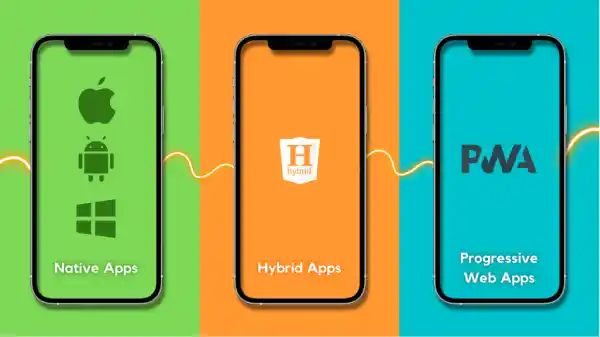
Selecting the right mobile architecture is one of the most critical technology decisions a business can make. Choose the wrong approach, and you risk burning months of development capital on an over-engineered native app your market doesn't need—or building a lightweight web wrapper that fails to perform when your users demand fluid responsiveness and offline capabilities.
With technological advancements in modern mobile frameworks, the options have evolved far beyond the old debate of "slow hybrid apps vs. expensive native code." Today, technical leaders can choose between Native iOS & Android, modern compiled Cross-Platform frameworks (React Native, Flutter), and Progressive Web Apps (PWAs).
In this architectural guide, we break down each model's underlying mechanics, hardware access capabilities, cost structures, and real-world trade-offs so you can make an informed technical decision.
Deconstructing the Three Mobile Architectures
1. Native Mobile Development (Swift for iOS, Kotlin for Android)
Native development involves building separate, platform-specific codebases using Apple's and Google's official languages and development environments (Xcode with Swift/SwiftUI, Android Studio with Kotlin/Jetpack Compose).
- Under the Hood: Code compiles directly into native ARM machine instructions with direct access to operating system APIs. There is zero bridge overhead or intermediate abstraction layer.
- Key Strengths: Flawless 120Hz rendering, immediate access to newly released OS features on launch day, robust background execution, and deepest integration with hardware sensors (Bluetooth Low Energy, LiDAR, NFC, biometrics, Apple HealthKit / Google Fit).
- Trade-offs: High cost and slow time-to-market. You must hire and maintain two separate engineering teams (iOS and Android), write all business logic twice, and manage two distinct deployment pipelines.
2. Modern Compiled Cross-Platform (React Native & Flutter)
Modern cross-platform frameworks have replaced outdated WebView wrappers (like Cordova and Ionic). Instead of running inside an embedded browser, frameworks like React Native and Flutter compile into native UI widgets and native machine binaries from a single unified codebase.
- Under the Hood:
- Flutter: Compiles Dart code directly into native ARM machine code using Google's Skia or Impeller rendering engine, drawing every pixel directly onto a native canvas.
- React Native: Utilizes the New Architecture (Fabric rendering engine, TurboModules, and the JavaScript Interface / JSI) to execute JavaScript code directly with native C++ bindings without the old asynchronous JSON bridge.
- Key Strengths: Single codebase sharing 85% to 95% of business logic and UI components across both iOS and Android. Rapid development cycles with Hot Reloading, massive developer ecosystem, and near-native performance for standard UI interactions.
- Trade-offs: Complex native SDK integrations (e.g., custom C++ audio libraries or novel Bluetooth protocols) still require writing custom native bridging code. Framework version upgrades require careful dependency management.
Explore our deep expertise in Flutter app development and React Native app development.
3. Progressive Web Apps (PWAs)
A Progressive Web App is a standard web application built using modern HTML5, CSS3, and JavaScript that leverages Service Workers and Web App Manifests to deliver an app-like user experience inside mobile browsers.
- Under the Hood: PWAs run within the browser sandbox (Chromium on Android, WebKit on iOS). Service workers handle background data caching, offline page loading, and web push notifications.
- Key Strengths: Zero App Store friction. Users install the app directly from your website to their home screen with a single tap, bypassing the Apple 30% fee, App Store review delays, and app updates. Maximum SEO discoverability and lowest initial development cost.
- Trade-offs: Restricted hardware access (no background geolocation, limited Bluetooth, no NFC on iOS). Apple's WebKit enforces strict storage limits and can evict cached data if the app is left unopened for over 7 days.
Comprehensive Mobile Architecture Comparison Matrix
| Evaluation Factor | Native (Swift / Kotlin) | Cross-Platform (Flutter / React Native) | PWA (Progressive Web App) |
|---|---|---|---|
| Codebase Architecture | Two separate codebases (100% duplicate logic) | Single unified codebase (85–95% shared logic) | Single universal web codebase (100% shared) |
| Rendering Performance | Maximum (120 FPS fluid, zero abstraction) | Near-Native (60–120 FPS for standard applications) | Browser-dependent (Good for content, poor for heavy animations) |
| Hardware & Sensor Access | Full, unrestricted access to all device APIs | Access via standard plugins and custom native bridges | Severely restricted (Limited sensor and background access) |
| Distribution & App Stores | Apple App Store & Google Play Store mandatory | Apple App Store & Google Play Store mandatory | Direct web distribution via browser URL; no store approval |
| Time-to-Market (MVP) | Slow (14–24 weeks for both platforms) | Fast (8–14 weeks for both platforms) | Fastest (4–8 weeks) |
| 24-Month Maintenance Cost | High (Maintaining dual platform roadmaps and updates) | Moderate (Single team maintaining one codebase) | Low (Standard web infrastructure maintenance) |
| Offline Functionality | Full offline support via local SQLite / Realm | Full offline support via SQLite / WatermelonDB | Basic offline caching via Service Worker Cache API |
Scenario-Based Architecture Recommendations
Scenario A: The Hardware-Intensive Consumer Product → Choose Native
If your application requires continuous background geolocation tracking (e.g., real-time fitness telemetry, turn-by-turn navigation), complex IoT Bluetooth Low Energy pairing, augmented reality (ARKit/ARCore), or high-frame-rate 3D rendering, Native is the only responsible technical choice.
Scenario B: The B2B SaaS Companion or E-Commerce App → Choose Cross-Platform
If you are building an on-demand marketplace, an e-commerce platform, a B2B productivity tool, or a social network, modern Cross-Platform (Flutter or React Native) provides the optimal balance. You achieve 95% native performance, launch on both App Stores simultaneously, cut your development budget by 35%, and maintain a single agile engineering team.
Scenario C: The Content Portal, MVP, or Internal Directory → Choose PWA
If your primary goal is rapid market validation, content distribution, or internal employee workflows without requiring App Store approval or deep device sensor integrations, building a Progressive Web App is the most capital-efficient approach.
Choosing the Right Mobile Foundation
Selecting between native Swift/Kotlin, cross-platform Flutter/React Native, and Progressive Web Apps comes down to your hardware requirements, performance goals, development budget, and distribution strategy.
Our mobile team builds across all three architectures, helping founders and product leaders choose the right technical approach for their roadmap. If you are planning a mobile application, contact us to evaluate the best technical fit for your project.