
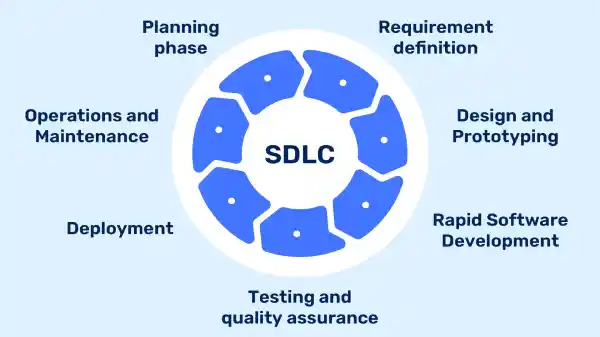
A company can spend hundreds of thousands of dollars building an application and still end up with software that is sluggish, fragile to update, or mismatched with user needs. When software projects stall or fail to deliver return on investment, the culprit is rarely the developers' coding ability. In almost every case, the root cause is a broken or poorly governed Software Development Lifecycle (SDLC).
Taking an idea from a whiteboard sketch to a production-grade application requires structured discipline. It demands clear separation of concerns across product discovery, system architecture, UX design, sprint execution, quality assurance, and automated release engineering.
Whether you are a startup founder building an initial MVP or an enterprise leader modernizing core business systems, this guide breaks down how a mature engineering team executes each stage of the software development lifecycle.
Phase 1: Product Discovery and Requirements Engineering
The single most expensive mistake in software development is writing code before validating business logic and technical feasibility. Product discovery establishes the blueprint for the entire project.
During discovery, technical architects, business analysts, and product managers collaborate to de-risk the product. This phase focuses on three core deliverables:
- User Story Mapping & Scope Definition: Breaking high-level concepts into granular, testable user stories with defined acceptance criteria. Features are prioritized using frameworks like MoSCoW (Must-have, Should-have, Could-have, Won't-have) to define a lean, viable scope.
- Technical Feasibility & Architectural Spikes: Identifying high-risk technical unknowns early—such as legacy API constraints, third-party service dependencies, or real-time latency thresholds—and building rapid proof-of-concept prototypes to validate assumptions.
- Non-Functional Requirements (NFRs): Formulating explicit targets for concurrent user load, maximum acceptable latency (p95 and p99 response times), data residency regulations (GDPR, HIPAA, DPDP), and uptime Service Level Agreements (SLAs).
Investing 2 to 3 weeks in structured discovery typically prevents months of costly rework during active development.
Phase 2: UI/UX Architecture and Interactive Prototyping
User experience is not merely visual styling; it is the structural logic of how information flows through the application. A well-engineered user interface minimizes cognitive friction, guides user workflows, and eliminates unnecessary clicks.
The UI/UX workflow follows an iterative validation pipeline:
- Information Architecture & User Flow Mapping: Defining the taxonomy, navigation tree, state transitions, and error-recovery paths for every user persona.
- Low-Fidelity Wireframing: Establishing layout hierarchy, data density, and interaction patterns without visual distractions.
- Design Systems & Component Libraries: Creating a unified design system in Figma using atomic design principles, global color tokens, typography scales, and responsive layout grids that map directly to frontend component libraries.
- Clickable High-Fidelity Prototypes: Conducting usability testing on interactive prototypes with real users to identify navigation choke points before a single line of frontend code is written.
Learn more about how our team approaches UI design systems and visual branding and UX research and usability testing.
Phase 3: System Architecture, Database Modeling & Tech Stack Selection
Before writing feature code, system architects design the foundational software blueprint. The choices made here determine how easily the application will scale as traffic grows.
Key architectural decisions include:
- Application Pattern: Evaluating whether a well-structured modular monolith or a decoupled microservices architecture is appropriate. For most early-stage and mid-scale applications, a modular monolith using frameworks like Next.js or NestJS reduces operational complexity while keeping deployment fast.
- Database Architecture & Schema Modeling: Designing relational (PostgreSQL, MySQL) or document-based (MongoDB) schemas, normalization strategies, foreign key constraints, indexing blueprints, and connection pooling.
- API Contract Design: Standardizing RESTful endpoints or GraphQL schemas with OpenAPI/Swagger specifications, ensuring frontend and backend developers can work concurrently against mock servers.
- Security & Authentication Architecture: Establishing OAuth2/OIDC workflows, JSON Web Tokens (JWT) with secure HTTP-only cookies, role-based access control (RBAC), and encryption at rest and in transit.
Phase 4: Agile Sprint Execution and Continuous Integration
Active development is executed in iterative 2-week sprints under Scrum or Kanban methodologies. Rather than waiting months for a monolithic "big bang" release, working software is delivered at the end of every sprint.
A high-performing engineering workflow enforces strict engineering standards:
- Branching Strategies: Using Gitflow or trunk-based development with short-lived feature branches, preventing merge conflicts and drift.
- Peer Code Reviews: Requiring at least two peer reviews on pull requests to enforce code quality, architectural consistency, and security best practices.
- Automated CI Pipelines: Triggering automated linting (ESLint, Prettier), static analysis (SonarQube), and automated unit tests on every pull request before code can be merged into the main branch.
- Sprint Demos & Transparent Tracking: Hosting biweekly sprint reviews where stakeholders inspect live, working functionality on staging environments, tracked via Jira or Linear.
Explore our engineering capabilities in web application development and custom software development.
Phase 5: Multi-Tier Quality Assurance & Performance Testing
Quality assurance is not a final checkpoint tacked onto the end of a project; it runs in parallel with development. Comprehensive testing ensures software reliability under real-world conditions.
Our QA matrix covers four critical layers:
- Automated Unit & Integration Testing: Testing individual functions, business logic, and API endpoints using frameworks like Jest, Mocha, and Supertest to maintain high test coverage.
- End-to-End (E2E) Testing: Simulating real user interactions across critical business funnels (e.g., user signup, checkout, report generation) using Playwright or Cypress.
- Load & Stress Testing: Simulating high concurrent user traffic and spikes using tools like k6 or Apache JMeter to identify database deadlocks, memory leaks, and server bottlenecks.
- Security Audits: Conducting OWASP Top 10 vulnerability scans, dependency audits (npm audit, Snyk), penetration testing, and rate-limiting validation.
Discover our comprehensive approach to manual and automated testing services.
Phase 6: Cloud Infrastructure and Zero-Downtime Deployment
Deploying software to production must be repeatable, automated, and resilient. Manual FTP uploads and manual server configurations are relics of the past.
Modern deployment engineering relies on cloud-native infrastructure:
- Containerization: Packaging applications into immutable Docker containers to guarantee absolute consistency between local development, staging, and production environments.
- Infrastructure as Code (IaC): Provisioning cloud resources on AWS, Google Cloud, or Microsoft Azure using Terraform, making infrastructure version-controlled and reproducible.
- Zero-Downtime Releases: Implementing Blue-Green deployments or Canary releases where traffic is seamlessly shifted from old containers to healthy new containers without a second of user disruption.
- Continuous Delivery (CD): Automating deployment pipelines via GitHub Actions or GitLab CI to ship tested code to staging and production automatically upon approval.
Check out our expertise in CI/CD pipelines and AWS cloud architecture.
Phase 7: Production Telemetry, SLA Support & Iterative Scaling
Launching the application is the beginning of the product lifecycle, not the end. Once live users interact with the system, continuous observability and maintenance ensure sustained performance.
Post-launch governance includes:
- Real-Time Observability: Tracking error rates, stack traces, and uncaught exceptions with Sentry, combined with application performance monitoring (APM) via Datadog or Prometheus.
- Database Optimization & Index Tuning: Analyzing slow query logs as data volumes grow and tuning indexes to maintain sub-second response times.
- Security Patching & Dependency Upgrades: Regularly upgrading framework versions, applying security patches, and rotating cryptographic keys.
- Feature Iteration Roadmapping: Analyzing user behavioral telemetry (via Mixpanel or PostHog) to guide the next phase of product enhancements.
Development Methodologies: Comparing Approaches
Selecting the right development framework depends on project scope, timeline rigidity, and requirement clarity:
| Framework | Best Suited For | Key Strengths | Trade-offs |
|---|---|---|---|
| Agile Scrum | Evolving products, SaaS platforms, long-term roadmaps | High flexibility, biweekly working increments, continuous stakeholder feedback | Requires active stakeholder participation and ongoing backlog grooming |
| Kanban | Maintenance teams, continuous support, operational tooling | Continuous flow, instant prioritization, minimized cycle times | Less structured milestone predictability for large multi-team builds |
| Shape Up | Product-led startups with clear 6-week release appetites | Fixed-time, variable-scope execution; prevents project drag and scope creep | Requires experienced senior developers capable of autonomous technical shaping |
Applying SDLC Discipline to Your Application
A predictable software development lifecycle combines structured discovery, sprint-based delivery, automated test gates, and continuous cloud deployment to keep development on schedule and maintainable over time.
We provide dedicated engineering squads—including architects, full-stack developers, QA engineers, and DevOps specialists—to guide applications through each delivery phase. If you have an application project to scope, get in touch with our technical leads.