Every growing company eventually hits the "SaaS ceiling." In the early stages, commercial off-the-shelf (COTS) software seems like a sensible shortcut: you sign up, swipe a credit card, and within hours your team has a CRM, an inventory tracker, or an operational dashboard. But as your business matures, your workflows become more specialized, your customer expectations rise, and those generic tools begin to push back.
Soon, teams find themselves juggling 12 different SaaS subscriptions, paying hundreds of dollars per user per month, and spending hours manually copying data between systems connected by brittle automation webhooks. The software that was supposed to accelerate business operations ends up dictating how your company is allowed to operate.
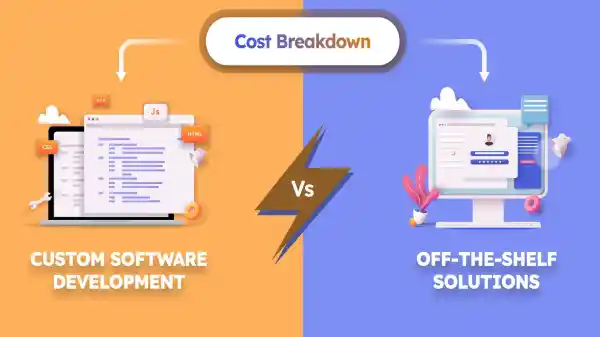
This is where the strategic decision between commercial off-the-shelf software and bespoke custom software becomes critical. Understanding the trade-offs, financial models, and long-term business implications will determine whether your software remains a recurring operational expense or becomes a compounding competitive advantage.
The Hidden Costs of the "SaaS Sprawl" Trap
While off-the-shelf SaaS solutions offer low barrier-to-entry pricing, the hidden total cost of ownership (TCO) escalates dramatically as your organization scales:
- The Per-Seat Tax on Growth: Most SaaS tools charge on a per-user, per-month basis. When your team grows from 20 to 150 employees, software expenses multiply exponentially—even though your fundamental usage of the platform has not changed.
- Feature Bloat and Missing 20%: Most off-the-shelf platforms are designed to satisfy the broadest possible market. You end up paying for dozens of complex features your team never uses, while the 20% of specialized functionality unique to your business logic is completely unsupported.
- Vendor Lock-in & Pricing Volatility: When a third-party vendor raises subscription prices by 30%, alters API rate limits, or deprecates features your team relies on, you have zero leverage. Your core operations are hostage to their roadmap.
- Fragile "Zapier Glue" Architectures: Connecting disjointed SaaS platforms using third-party webhooks creates a brittle data ecosystem. A single schema update in one tool can silently break synchronization pipelines, leading to data corruption and lost revenue.
The Build vs. Buy Decision Matrix
Experienced technical leaders know that custom development is not the answer for every problem. The goal is to build where you differentiate, and buy where you standardize.
| Dimension | Off-the-Shelf SaaS (Buy) | Custom Software (Build) |
|---|---|---|
| Core Application | Standard commodity functions (Payroll, basic accounting, transactional email) | Core business workflows, proprietary IP, unique customer portals, specialized operations |
| Cost Structure | Low initial CapEx, high and recurring OpEx that compounds with user growth | Higher upfront CapEx investment, predictable and minimal ongoing maintenance OpEx |
| Workflow Fit | Requires your business to adapt its processes to the tool's predefined constraints | Engineered specifically to mirror and streamline your company's exact operational logic |
| Data Ownership | Data resides in third-party vendor clouds subject to their export limits and terms | Complete data sovereignty, unrestricted database access, and total compliance control |
| Integration Flexibility | Constrained by vendor-provided APIs, rate limits, and third-party connector fees | Unrestricted custom API endpoints, direct database hooks, and event-driven architecture |
Five Compounding Advantages of Custom Software
1. Tailored Business Logic That Creates Competitive Moats
When you use the exact same software as your competitors, your operational efficiency is capped at the exact same ceiling as theirs. Custom software allows you to automate proprietary workflows, calculate dynamic pricing algorithms, and deliver differentiated customer experiences that off-the-shelf tools cannot replicate.
For example, a specialized logistics company might require multi-variable route optimization based on real-time driver availability, toll rates, and hazardous materials compliance. Attempting to force that workflow into a generic field management app requires clunky manual workarounds. A custom platform automates the entire process in milliseconds.
2. 3-Year Total Cost of Ownership (TCO) Economics
Consider a mid-sized enterprise with 100 employees using five core SaaS tools (CRM, project management, inventory, invoicing, and reporting) averaging $50 per user/month per tool:
100 users × $250/month = $25,000/month → $300,000 per year → $900,000 over 3 years.
Building a centralized custom software platform that integrates all five domains might require an initial capital investment of $120,000 to $180,000, plus $20,000/year for cloud infrastructure and maintenance. Over a three-year period, the custom system delivers over $650,000 in net cost savings while providing an asset that adds direct equity value to the business balance sheet.
3. Seamless Enterprise Integration & Unified Data
In custom software, every module shares a unified database schema. Customer records, order history, inventory allocations, and accounting ledger entries live within a single relational database (such as PostgreSQL), eliminating data silos and duplicate entry. Reporting dashboards pull real-time analytics directly from production data without waiting for nightly batch exports.
Explore our architectural approach to custom software development and web application development.
4. Total Data Sovereignty and Regulatory Compliance
In industries such as healthcare, financial services, legal tech, and supply chain management, data residency and strict compliance (HIPAA, GDPR, SOC 2, ISO 27001) are mandatory. Custom software gives you complete control over:
- Where data is physically stored (e.g., specific AWS or Azure data centers in required jurisdictions).
- Granular role-based access control (RBAC) and audit logging for every read and write operation.
- End-to-end encryption keys owned exclusively by your organization.
5. Unconstrained Scalability and Feature Evolution
As your company expands into new markets, adds service lines, or acquires subsidiaries, custom software evolves with you. You are never forced to migrate platforms simply because you exceeded a 50,000-record limit or need to support multi-currency localized taxation. New modules are designed and deployed onto your existing architecture without friction.
See how we build scalable cloud platforms in our SaaS product development services and Node.js backend architectures.
How to Transition from Off-the-Shelf Tools to Custom Software
Migrating away from legacy SaaS tools does not require shutting down business operations. Mature engineering teams use the Strangler Fig Pattern:
- Audit and Identify the Core Bottleneck: Map your existing SaaS stack and pinpoint the single tool causing the highest subscription cost or operational friction (e.g., inventory management).
- Build the Core Module First: Engineer a custom replacement for that single domain, connecting it to your remaining SaaS tools via standard APIs.
- Dual-Run and Validate: Run the custom module in parallel with the legacy tool for a defined period to ensure data integrity and user adoption.
- Systematically Replace Remaining Modules: Incrementally migrate adjacent workflows (CRM, billing, reporting) into the custom system until the legacy tools are fully decommissioned.
Evaluating Custom Software for Your Business
Commercial software works well for standard back-office tasks, but custom software becomes valuable when your business logic, pricing rules, customer portals, or data security needs outgrow generic SaaS platforms.
We help businesses assess build-versus-buy trade-offs, map migration roadmaps using patterns like the Strangler Fig, and engineer purpose-built internal and customer-facing software. If you are evaluating a custom platform, reach out to review your technical requirements with our team.